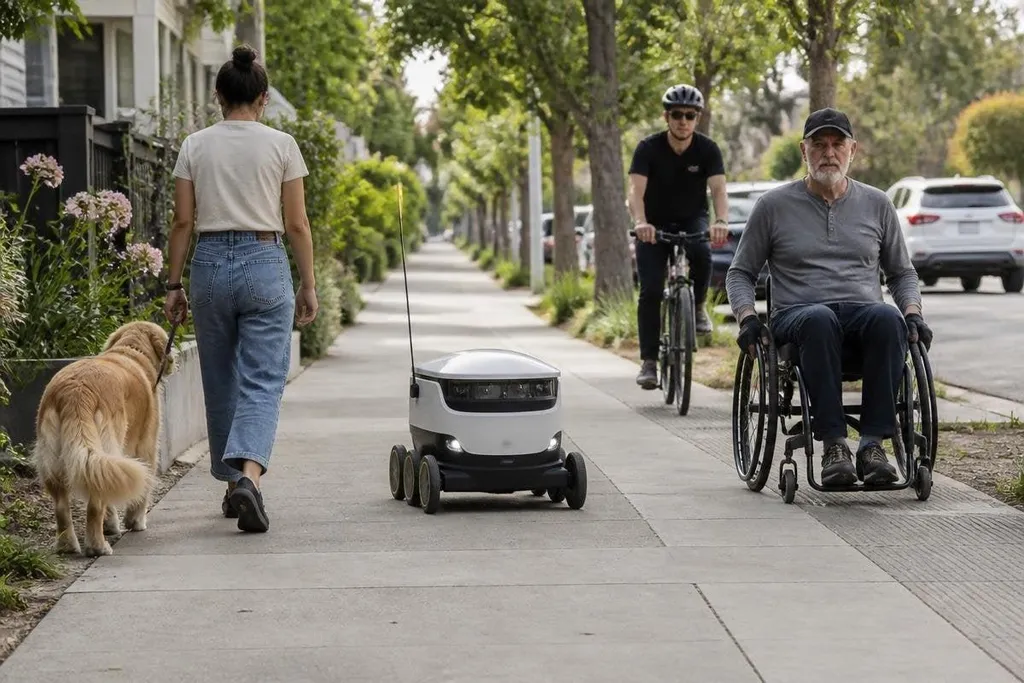
A sidewalk robot has to share space with people, wheelchairs, bicycles, pets, driveways, and uneven paving. That makes its useful task easy to describe, but its safety case harder to prove without site-specific evidence.
- Useful job: move small goods over short routes without a driver inside the vehicle.
- Main risk: a blocked or crowded sidewalk can turn a simple route into a safety problem.
- Buyer’s test: ask who can stop the robot, recover it, and pay for repairs.
What sidewalk robots can do
The basic idea is narrow. A robot carries a small load from a store, kitchen, or local depot to a nearby address, then returns or waits for collection. That could reduce the number of short vehicle trips needed for small deliveries.
The robot’s size also matters. A small vehicle may use less energy than a full-size delivery van for a short trip, but that claim depends on the full route, charging method, load, and support work behind it.
A robot still needs people to load it, monitor it, repair it, and collect it when a route fails. That support work is easy to miss. A delivery that looks autonomous from the pavement may still depend on remote staff when a gate is closed, a ramp is blocked, or a person stands in the robot’s path.
The sidewalk is a difficult work area
Roads have lanes and traffic rules. Sidewalks rarely offer that level of order. Their width changes, surfaces crack, and temporary obstacles appear without warning. The robot must read its surroundings and choose a safe speed while leaving room for people to pass.
Sensors can help the robot detect objects and map its route. They don't remove the need for careful local rules. A sensor may see a chair or a person, but the robot still needs a safe response when the path narrows or someone moves around it.
Access is another test. A route that works for a person walking freely may fail for someone using a wheelchair or pushing a stroller. Any trial should check clear passage, curb ramps, crossings, and building entrances before it counts a delivery as successful.
Who carries the risk?
A sidewalk robot can stop when its battery runs low, a sensor reports an obstacle, or its network connection drops. The useful question is what happens next. If the robot blocks a ramp for ten minutes, the public deals with the result even if the operator is somewhere else.
Clear ownership matters. The operator needs a way to monitor the robot, speak to people nearby, send help, and record incidents. Local authorities also need access to rules for speed, parking, lighting, noise, and removal from public space.
Privacy needs the same care. Cameras and other sensors may collect images or location data while the robot moves. A responsible trial should explain what the robot records, how long it keeps that data, and who can access it.
A public sidewalk trial records the robot’s route, speed, stop rules, and human support. Sidewalk robot reporting from Robot24.com can put those facts beside claims about safety and access, setting up the evidence still missing.
What evidence is still missing
A smooth demonstration proves that a robot can complete one route under selected conditions. It doesn't prove that the system can handle a busy sidewalk over many weeks. The useful record should include failed trips, blocked routes, remote interventions, damaged equipment, and complaints.
Cost also needs a full count. Include the robot, charging equipment, staff, insurance, repairs, software, and any local permit work. A low delivery price on paper may change when each failed trip needs a person in a vehicle.
I'd support sidewalk robots only where the operator can show safe access, fast recovery, and clear responsibility for every incident.
A practical decision check
Before approving a trial, ask:
- Route: Can a wheelchair user pass when the robot is stopped?
- Control: Can a human stop it from a remote console and at the robot itself?
- Recovery: Who reaches it when a route is blocked, and how fast can they arrive?
- Privacy: What sensor data is collected, stored, and deleted?
- Cost: Does the budget include staff time, repairs, insurance, and failed trips?
- Proof: Will the operator publish safety events and remote-control rates?
The next useful test is not a staged delivery on an empty path. It is a public route with clear access rules, recorded failures, and a named person responsible when the robot stops.